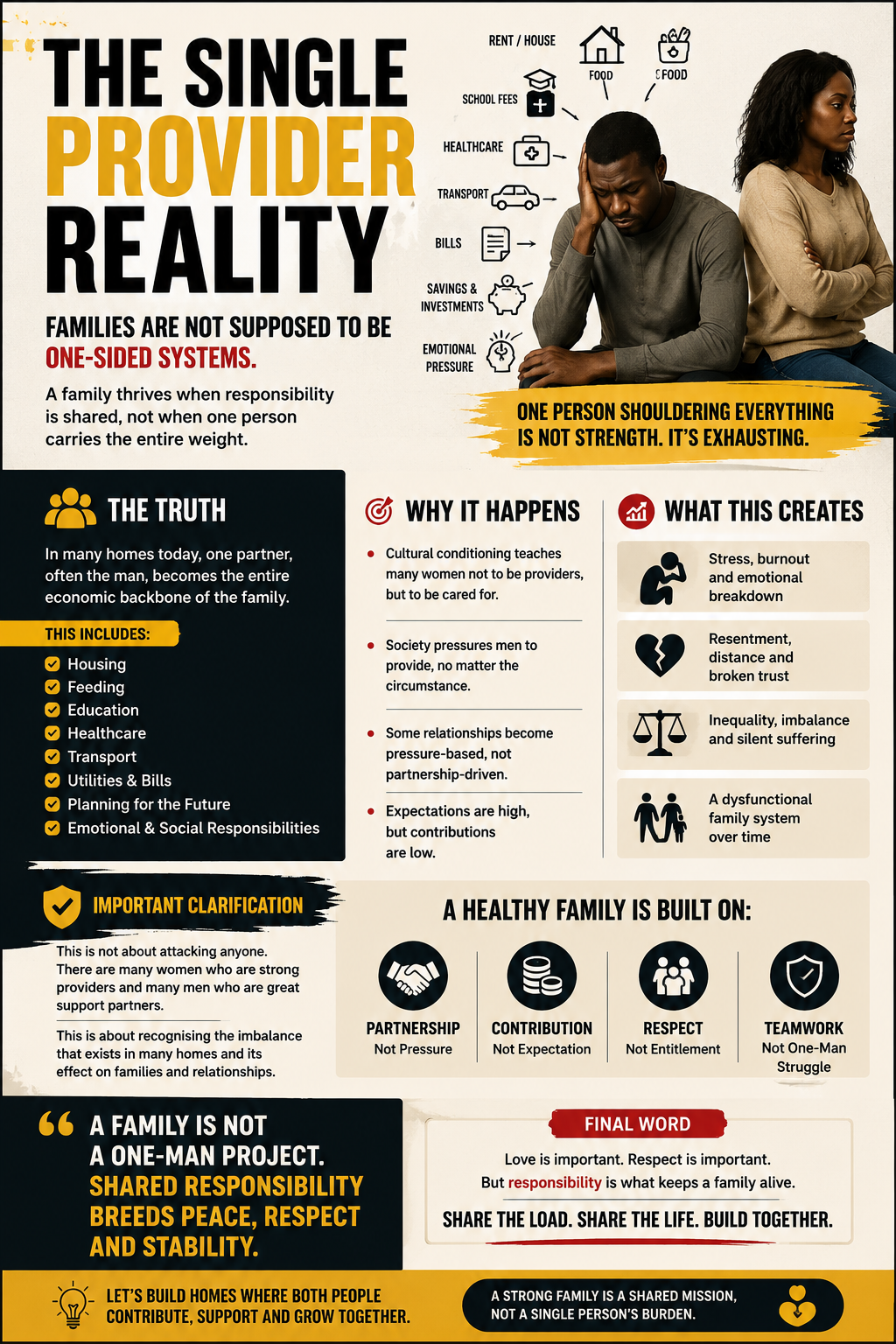
INTRODUCTION.
There is a growing tension in how modern families function versus how they are imagined. In theory, family responsibility is shared. In practice, many households today operate on what can only be described as a single-provider structure, where one parent carries the overwhelming weight of survival, while the other contributes little or nothing economically. This is not a myth. It is a lived reality in many homes.
1. The Idea vs The Reality of Family Contribution
In an ideal family system, both parents contribute. Contribution may differ in form—income, caregiving, emotional support, household management, but the system remains balanced in function.
However, in many modern households, especially in developing economies like Nigeria, the structure has shifted. Increasingly, one parent—often the man, becomes the primary or exclusive provider, while the other role becomes less economically engaged. This is where the tension begins.
2. The Cultural Shift in Roles
One of the less discussed realities is that social conditioning has influenced expectations in relationships and marriage. In some environments, many women are raised with the expectation that:
providing financially is primarily the man’s duty
their role is more centred around support, companionship, and home management, financial pressure is something to be “handled” by the husband or partner.
At the same time, many men are raised under the expectation that:
they must provide, regardless of circumstance,
failure to provide equals failure as a man,
support from the partner is optional, not guaranteed.
The result is predictable: asymmetric responsibility structures.
3. When One Person Becomes the Entire System
In practice, this dynamic often produces a situation where:
The man pays rent.
The man funds food, transport, school fees, healthcare.
The man carries financial planning and emergency burdens.
The man is still expected to perform emotional and social responsibilities.
Meanwhile, in some relationships:
financial contribution from the woman is minimal or absent, expectations still remain high on lifestyle and provision, emotional pressure becomes the main form of participation
This creates a structure where one person is not just a provider, but effectively the entire economic backbone of the household.
4. The Pressure Economy Inside Relationships.
When contribution is one-sided, relationships begin to shift from partnership to pressure-based systems. The provider becomes:
• financially responsible
• emotionally accountable
• socially evaluated based on output
While the non-provider role, in some cases, becomes centred around:
• expectation management
• lifestyle pressure
• emotional negotiation rather than economic contribution
This imbalance is where frustration often builds—not necessarily from absence of love, but from unequal load-bearing.
5. Important Clarification: This Is Not Universal
It is important not to overgeneralise.
There are many households where:
• women are active providers
• both partners share financial responsibility
•or the woman is the primary earner
But the concern being raised is about a noticeable pattern in some environments, not a universal rule. Family systems are shaped heavily by:
• upbringing
• economic conditions
• cultural expectations
• personal choices
So outcomes differ widely.
6. The Core Issue: Contribution vs Expectation.
At the heart of this discussion is not gender war, but balance. A functional family system requires:
• contribution (financial or non-financial)
• accountability
• shared burden of survival
When expectation consistently exceeds contribution on one side, the system becomes strained, no matter who is involved.
CONCLUSION
The modern family is not failing because one provider exists. It becomes strained when one person carries the system while the other primarily benefits from it without equivalent contribution. Whether in marriage or long-term relationships, sustainability depends less on who earns and more on whether responsibility is truly shared in a meaningful way.
Because in the end, a family is not just a structure of love or expectation, it is a structure of shared survival, Goals, achievement, teamwork, support, dedication, willingness to grow together, it is a union, two flesh becoming one, not a competitive ground, or a ground to proof points, or a game that determines who wins. It is a commitment. Don't venture if you cannot.